
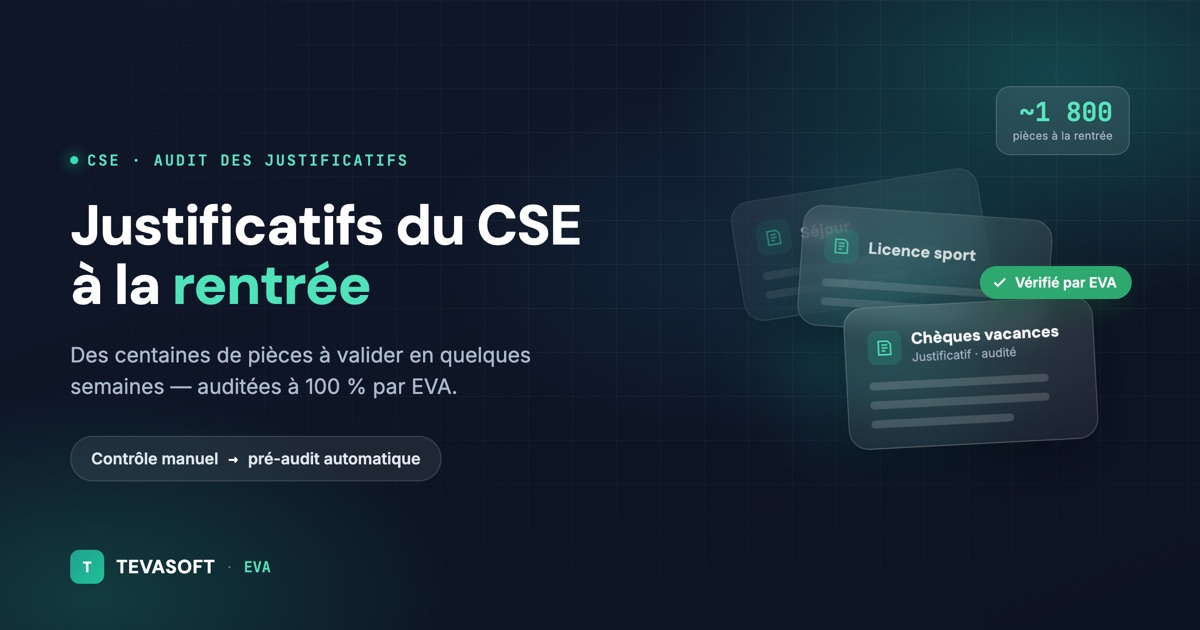
CSE receipts at back-to-work: how many to validate, and how to go fast
The back-to-work season is the CSE's receipt peak
Holiday vouchers, summer stays, kids' camps, sports memberships, cultural subscriptions: when everyone returns from vacation, subsidy claims all land at once. Within a few weeks, elected members must validate what amounts to a large share of the year's works-council (CSE) benefit reimbursements.
The rule isn't the problem — a receipt proves the expense — the concentrated volume is. A CSE representative, often a volunteer, ends up with hundreds, sometimes thousands of documents to check, each meant to be verified: named beneficiary, cap, eligibility, proof of payment.
A concrete order of magnitude
Take a CSE of 500 employees. At the back-to-work season, each can submit several receipts — holiday vouchers, a stay, a child's sports membership, a cultural subscription.
At 3-5 minutes of serious checking per document, the arithmetic breaks down. Either members skim, or processing drags on for weeks — and honest employees wait for their reimbursement.
Checking fast doesn't mean checking badly
The usual reflex is to pick between two evils: validate quickly with eyes closed, or check properly and accept long delays. CSE management platforms handle the flow — submission, tracking, payout — but do not rule on whether a receipt's content is genuine.
That is exactly where the time goes: reading an invoice is fast, authenticating it is not. Checking that a rental host exists at the stated address, that a total isn't set right at the cap, that the same document hasn't already been filed elsewhere — done by hand, at back-to-work scale, is impossible.
How EVA speeds up validation
EVA, Tevasoft's receipt audit engine, reviews 100% of documents before payout and returns a reasoned verdict. The representative doesn't become an investigator: they handle flagged cases first.
- Automatic audit of every receipt: provenance metadata (including the C2PA signature of AI-generated images), consistency of amounts, dates and layout.
- Issuer verification: SIRET, VAT and the vendor's real existence checked against official registries.
- Duplicate detection: each document is cross-checked against all claims already filed, across every employee and scheme.
- CSE rules & URSSAF thresholds: named beneficiary, caps, eligibility and proof of payment checked before payout.
- Archivable audit trail: every decision is logged with its document, ready for a URSSAF audit.
| Back-to-work step | Manual check | With EVA |
|---|---|---|
| Sorting risky documents | Each receipt read one by one | 100% pre-audit, doubtful cases surfaced |
| Vendor check (SIRET, address) | Manual lookup, often skipped | Automatic on every document |
| Duplicate detection | Members' memory | Systematic cross-check of history |
| Reimbursement lead time | Spread over several weeks | Focused on flagged cases only |
The result: members spend their time on the few genuinely doubtful files, not on the bulk. Honest employees are reimbursed faster, without blanket suspicion, and the committee keeps a complete audit trail.
In September, the bottleneck isn't the decision, it's the volume to verify. Auditing 100% of documents automatically keeps the load manageable — and control more reliable, not less.
Read more: receipt fraud, the CSE's blind spot and structuring the control of ASC reimbursements.
Want to see EVA audit your back-to-work receipts on your own data? Contact us.