
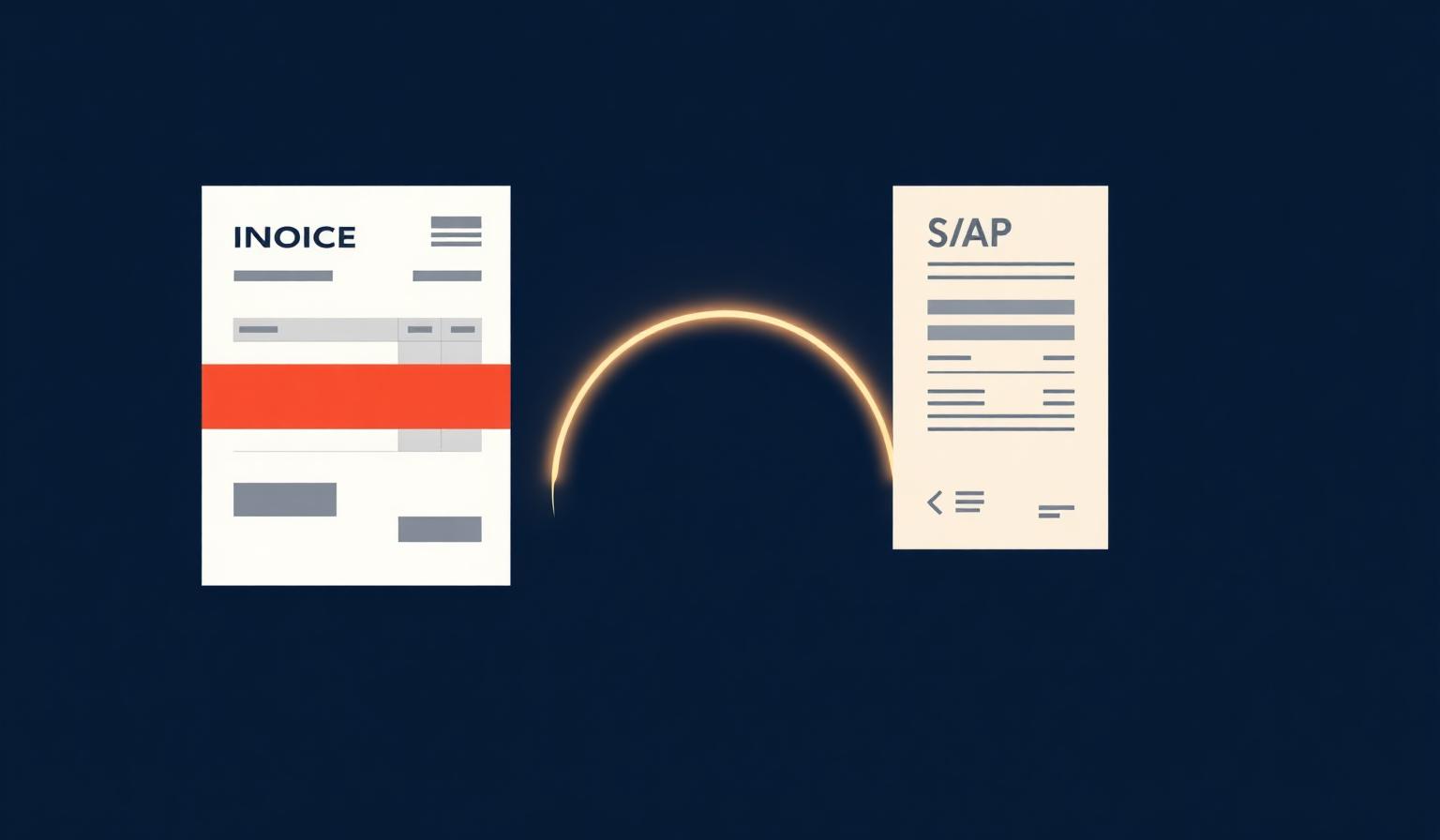
SAP Concur meets Poland's KSeF: how CONNECT closes the expense gap
Poland's e-invoicing mandate is live. Most companies running SAP Concur have a blind spot they don't see yet — and it sits exactly between a government invoice and an employee's expense line. Here's the gap, and how we close it.
The short version for busy CFOs
Since February 2026, Poland's National e-Invoicing System (KSeF) is mandatory. Every B2B invoice issued to a Polish company now passes through a single government platform.
That's great for tax authorities. It's a headache for finance teams — because KSeF was never designed to know which of your employees actually spent the money.
A KSeF invoice is tied to your company's tax ID. Your expense tool is tied to your employees. Nobody connects the two automatically. That reconciliation work lands on your finance team's desk, manually, one line at a time.
CONNECT by TEVASOFT is the bridge. It pulls the official KSeF invoice and matches it to the right expense report inside SAP Concur — automatically, at the moment the employee submits. No manual lookups, no VAT recovery left on the table.
What changed in Poland — and who it affects
KSeF (Krajowy System e-Faktur) became mandatory in two waves:
- 1 February 2026 — large companies, with annual turnover above 200 million PLN
- 1 April 2026 — all other VAT-registered businesses
One detail matters more than the dates: even if your issuing obligation starts later, every Polish company must be able to receive invoices through KSeF from February 2026. If you operate in Poland, you're already in scope as a buyer.
Only businesses established in Poland are subject to the mandate. Entities without a Polish establishment can use it voluntarily, but aren't forced to.
The blind spot: KSeF knows your company, not your people
Here's the heart of the problem, and it's worth slowing down on.
A KSeF invoice must carry the seller's and the buyer's details — names, addresses, and the NIP (Poland's company tax ID). For a B2B transaction, it's the buyer company's NIP that's required. Not the employee's.
So KSeF identifies the invoice at the company level, not the individual level. Every invoice gets a unique KSeF ID, linked to your company's NIP. Full stop.
Picture the everyday reality. One of your employees travels to Warsaw, stays two nights in a hotel, has a client dinner, takes a few taxis. The hotel issues a structured invoice to your company and sends it straight to KSeF. The invoice is now sitting in the government system, tagged with your company's NIP.
But which employee? Which trip? Which expense report? KSeF has no idea. And neither does your finance team, until someone manually connects the dots.
A new field in the latest invoice format — FA(3) — does let a supplier name the employee directly on the invoice. In practice, this field is optional and rarely filled: a hotel or restaurant usually doesn't know your employee's full name when it issues the document. So in the vast majority of cases, the invoice still lands in KSeF tied only to your company — not to a person.
Multiply that by hundreds of trips a month across dozens of employees, and you have a reconciliation problem that grows quietly until VAT recovery starts slipping and audit season gets painful.
A reality check on 2026
Not every expense flows through KSeF this year — and being clear about this matters.
A restaurant or taxi receipt only enters KSeF if several conditions line up: the employee asks for a proper B2B invoice with the company's NIP, the merchant is large enough to already be in scope, and the transaction clears the thresholds for simplified receipts. Many small Polish merchants don't fully join until 1 January 2027.
In practice, that means the strongest use case in 2026 is higher-value travel and expense spend — hotels booked in the company's name, car rentals, rail tickets, B2B services. These suppliers are rarely micro-businesses and issue full structured invoices today.
For everyday small spend, the volume ramps up sharply from January 2027, when paper receipts with a buyer NIP are phased out and KSeF becomes the mandatory channel. CONNECT is built for both the 2026 wave and the 2027 surge.
How CONNECT closes the gap
CONNECT sits between KSeF and SAP Concur and does the reconciliation work your team would otherwise do by hand. Here's the flow, step by step.
1. The supplier issues the invoice. The hotel, restaurant, or service provider sends a structured FA(3) invoice to KSeF, tagged with your company's NIP. KSeF validates it and assigns a unique KSeF ID.
2. The employee submits their expense. In SAP Concur, the employee enters the invoice reference and snaps a photo of the receipt. The merchant's tax ID is captured automatically by optical recognition — no extra typing.
3. CONNECT queries KSeF. The moment the expense report is submitted, CONNECT uses those two identifiers to find the matching official invoice inside KSeF and pull it back.
4. Reconciliation is validated. The government invoice is linked to the right expense line, for the right employee. VAT is recoverable, the record is audit-ready, and your finance team didn't lift a finger.
What used to be a manual hunt — finding the right invoice in a government portal and stapling it to the right expense — becomes an automatic match at the point of submission.
Why not just build it yourself?
Some teams will ask. It's a fair question, so here's the honest answer.
Connecting to KSeF directly means building and maintaining an API integration, managing security certificates and their renewals, and keeping pace with a regulation that keeps moving — new invoice schemas, new authentication rules, offline modes. KSeF recently shifted from token-based to certificate-based authentication, retiring the old method entirely. If your integration was built on tokens, it needed re-engineering before it broke.
That's a standing engineering commitment, not a one-off project. And it's not your core business.
With CONNECT, the KSeF connection runs natively inside SAP Concur. We handle the API plumbing, the certificates, the schema updates, and the regulatory watch. When the rules change, we change with them — so your team doesn't have to.
On top of that, CONNECT runs on a fully European stack: data hosted in the EU, GDPR-native by design. For a compliance tool handling your financial records, that's not a detail — it's the foundation.
The bigger picture
E-invoicing isn't just a Polish story. France's mandate arrives in September 2026, and the European ViDA directive is reshaping the rules across the continent. Poland's KSeF, Italy's SDI, France's reform — they're variations on the same theme, and the expense-reconciliation gap shows up in every one of them.
CONNECT is built as European compliance infrastructure for travel and expense, one country at a time, all inside the SAP Concur environment your teams already use.
If you run SAP Concur and operate in Poland, the gap is already there. The only question is whether your finance team closes it by hand — or lets CONNECT do it for them.
Want to see CONNECT match a live KSeF invoice to a Concur expense report? Get in touch — we'll walk you through it on your own data.