
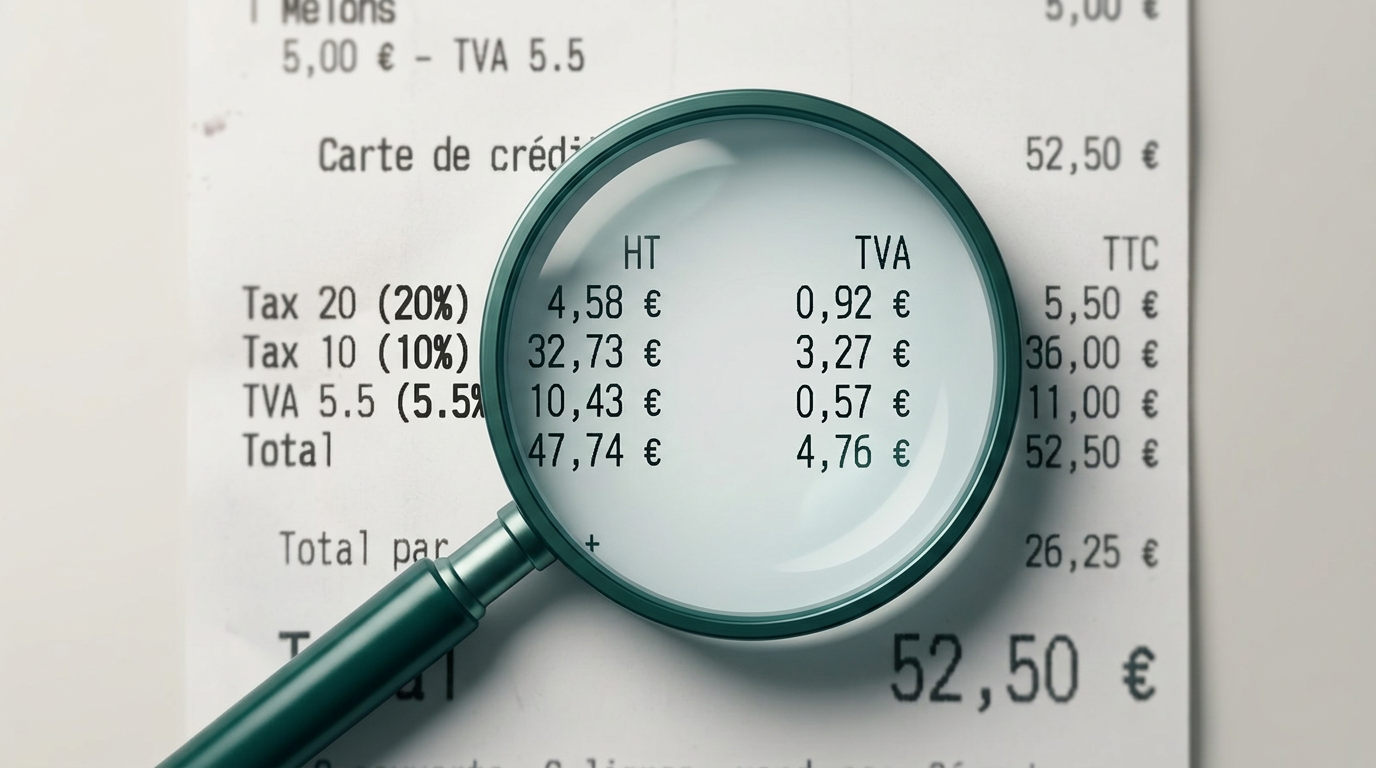
Multi-rate VAT on expense reports: thousands of euros sleeping in every restaurant bill
Every time an employee has dinner at a restaurant or stays at a hotel, the invoice contains up to three different VAT rates. Most expense management systems only process one. What your company does not reclaim, it loses for good.
One receipt, three VAT rates. Your ERP sees one.
Take a typical brasserie bill: a €18.50 main course, a €14 salad, €4.50 for mineral water, two glasses of Bordeaux at €19, two coffees at €6. Three VAT rates coexist on this single receipt:
- 5.5% on mineral water (food product)
- 10% on on-site catering
- 20% on alcohol
Faced with this receipt, your expense tool makes one of the two following choices — and both cost you.
Single rate per expense type
The tool maps "Lunch" to 10%. The whole receipt is processed at 10%, including the €19 of alcohol that belongs to the 20% rate. Result: 20% VAT never recovered on the alcohol share, and exposure to a tax reassessment if the auditor considers alcohol was treated at an incorrect rate.
Breakdown requested from the employee
They must create sub-expenses, compute the net base per rate and enter each line. In practice: either they lump everything under one rate (back to scenario A), or they get it wrong and Finance corrects it by hand. You pay for the employee's time, the frustration, **and** the accounting review.
Either way, you lose: employee time, reclaimable VAT, or both.
Four rates coexist under French tax law
| Rate | Category | T&E examples | Legal basis |
|---|---|---|---|
| 5.5% | Reduced | Food, mineral water | CGI art. 278-0 bis |
| 10% | Intermediate | On-site catering, hotel, transport | CGI art. 279 |
| 20% | Standard | Alcohol, minibar, car rental | CGI art. 278 |
| 2.1% | Super-reduced | Professional press, certain drugs | CGI art. 281 quater |
Their coexistence on a single invoice is the rule, not the exception.
Why your tools miss multi-rate VAT
1. A single VAT field per line. Most ERPs and T&E modules store one triplet: net, rate, gross. Multi-rate breakdown is structurally impossible without manual sub-expenses.
2. OCR that captures but does not analyse. Classic OCR reads the total but does not decompose the tax breakdown line by line.
3. No tax rules engine. Interpreting "VAT 10%: €4.50 / VAT 20%: €1.20" and mapping each amount to a deductible category requires a business engine most vendors never built.
EVA: extraction, structuring **and** posting back into your tool
EVA, TEVASOFT's smart audit layer, was built to see what other systems miss — then to put the information back in the right place.
- Smart tax OCR — analyses the full receipt structure, rate by rate, line by line.
- Multi-rate extraction — up to three VAT rates extracted independently, each with its taxable base.
- Posting back into SAP Concur — the split data is pushed into Concur's native tax fields. No re-entry for employees or Finance.
- Actionable CFO reporting — reclaimable VAT broken down by rate, category, employee, period.
- DGFiP compliance — automatic detection of inconsistencies before filing.
EVA does not produce a report alongside your tool: it enriches your tool. Accounting, VAT recovery and reporting all work on clean, structured data from day 1.
How much VAT is at stake? Two orders of magnitude.
The exact amount depends on three variables: number of travelling employees, average ticket, and the share of 20%-rated spend (alcohol, minibar, parking, rental). Two scenarios with stated assumptions.
Scenario 1 — Mid-market, 100 travelling salespeople
- 3 business lunches per week × 42 active weeks = 126 receipts/person/year
- Average ticket: €40 incl. VAT, of which 20% in alcoholic drinks
- VAT recovered if everything is treated at 10%: €3.64 per receipt
- VAT recovered with proper split: €4.24 per receipt
Scenario 2 — Large group, 800 travelling employees
Catering + hotel nights:
- Catering: 800 × 126 × €0.60 ≈ €60,000
- Hotel nights (50/yr, €130 incl. VAT, 10% at 20% rate): 800 × 50 × €1.00 ≈ €40,000
These figures assume a current "all-at-10%" execution. If your setup wrongly applies a higher rate on partially non-deductible items, the topic is no longer lost VAT but reassessment risk.
E-invoicing 2026 ready
EVA natively reads Factur-X and EN 16931 formats. Multi-rate breakdown becomes even more critical with structured invoices: above €150 net, the nominative e-invoice will be mandatory to reclaim VAT. EVA is ready.
Double penalty: reclaimable VAT permanently lost beyond the statute of limitations, and reassessment risk if incorrect rates were applied to partially non-deductible expenses.
How much VAT are you leaving asleep every year? Ask for an EVA demo on your own receipts — the multi-rate split appears in real time.