
AI-generated fake receipts: the new frontier of expense fraud
In March 2025, a TechCrunch journalist demonstrated in a few minutes that he could generate a perfectly realistic restaurant receipt with ChatGPT [1]. Coffee stains, paper creases, authentic typeface — the result was disturbingly convincing. Since then, the technology has only improved.
For finance departments, this evolution represents a major challenge. Traditional controls — visual inspection, basic duplicate detection, managerial approval — were simply not designed to handle forgeries of this quality.
The scale of the problem
Websites dedicated to creating fake receipts have existed for years. What's changing today is the quality and accessibility. Any employee with access to a generative AI tool can produce in seconds a receipt that would withstand any human visual inspection.
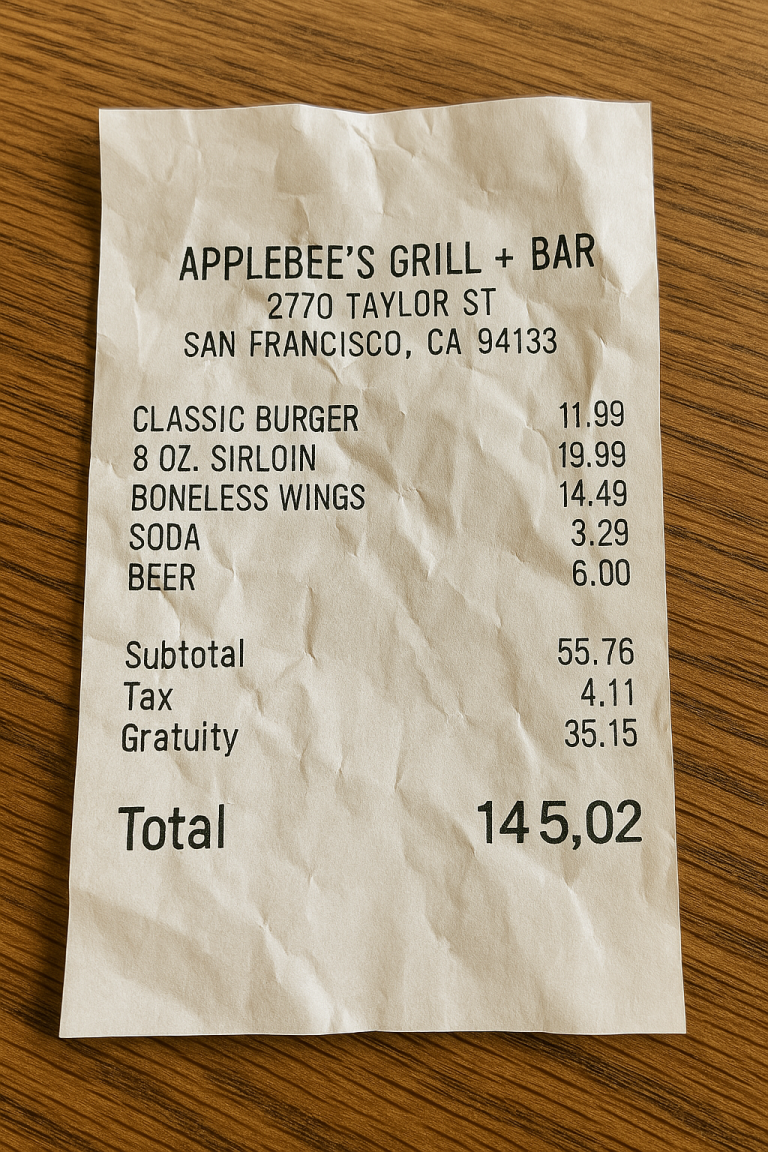
The most common techniques observed by our teams:
- Creation from scratch: an entirely fictitious receipt generated from a prompt describing a restaurant, an amount, and a date
- Alteration of real receipts: modification of the amount, date, or number of guests on an authentic receipt
- Hybrid receipts: combining elements from multiple real receipts to create a composite document
- Duplication with variations: the same receipt slightly modified, submitted by different employees or on different dates
What makes this new wave of fraud distinctive is that each forgery is unique. Unlike older techniques of photocopying or crude retouching, AI-generated receipts don't share obvious visual signatures with each other.
Why traditional controls fail
An experienced controller can spot a poor-quality photocopy or a blatantly inconsistent amount. But faced with an AI-generated receipt featuring the right visual codes — merchant typography, local VAT format, plausible sequential numbering — the human eye reaches its limits.
Traditional duplicate detection systems are no more effective: since each generated receipt is unique, it matches no existing document in the database.
The multi-layered approach: the only viable defense
Against this threat, a single detection strategy is insufficient. At TEVASOFT, we've developed a multi-layered approach combining several complementary methods:
Forensic image analysis
Our models examine image metadata, pixel consistency, compression artifacts, and digital signatures characteristic of generation tools. A receipt photographed with a smartphone and an AI-generated receipt present subtle but measurable differences in their digital structure.
Mathematical validation
Beyond the image, we verify arithmetic consistency: do the subtotals match the total? Is the VAT calculated at the correct rate? Are the amounts consistent with the establishment's typical prices? Image generators frequently make calculation errors that visual appearance doesn't betray.
Merchant data cross-referencing
EVA confronts each receipt against its merchant knowledge base: does the address exist? Do the opening hours match the expense date? Is the receipt format consistent with what this establishment typically issues? Is the tax ID valid?
Behavioral analysis
Fraud is almost never isolated. An employee who submits a fake receipt typically has an expense profile showing other weak signals: amounts systematically near approval thresholds, expenses concentrated on certain days, unusual frequency at certain merchants.
Statistical anomaly detection
By analyzing all expense reports across an organization, EVA identifies significant deviations from normal patterns: an employee whose restaurant expenses are 40% higher than peers in the same territory warrants particular attention, even if each individual receipt appears legitimate.
The race between creation and detection
It would be dishonest to claim that detection is infallible. Generation tools are progressing rapidly — and some fake receipts may temporarily escape our models. This is a reality any honest solution must face.
That's why we designed EVA with retroactive audit capability. When our detection models improve — which happens regularly — we can re-run analysis on old receipts that have already been reimbursed. A fake receipt that slipped through initial control in January can be identified during a retroactive sweep in July, thanks to a more capable model.
This approach transforms the arms race into a structural advantage for control teams: even if a fraudster manages to slip through today, the risk of being caught tomorrow increases continuously.
What finance leaders need to do now
The question is no longer whether your employees have access to tools capable of generating fake receipts — they do. The question is whether your controls are calibrated for this reality.
Three concrete actions are essential:
- Abandon sampling-based control: in a world of AI-generated receipts, checking 10% of expense reports means leaving 90% of risk unmonitored
- Invest in multi-layered detection: no single technique is sufficient — only the combination of image analysis, mathematical validation, and data cross-referencing provides effective protection
- Implement regular retroactive audits: detection models evolve — your past controls should be able to benefit from these improvements
Sources
[1] TechCrunch, ChatGPT's new image generator is really good at faking receipts, March 2025
[2] ACFE, Report to the Nations on Occupational Fraud and Abuse, 2024
[3] Gartner, Predicts 2026: AI Will Drive New Forms of Financial Fraud, 2025