
What we learned by plugging an AI agent into a real expense report flow
Not a demo. Not a chatbot. An autonomous agent able to read a receipt, cross-check card data, query the T&E policy and decide — approve, escalate or reject — with a natural-language justification. Here is what it actually looks like.
Why expense reports are an ideal field for agentic AI
Expense management has a paradox: it is a repetitive process, with relatively stable rules, that generates disproportionate human friction. Accounting teams spend considerable time vetting €15 fast-food receipts while €800 client-entertainment notes slip through because they are well written.
This is exactly the kind of task where a well-designed AI agent delivers immediate value: explicit rules, enough volume to make automation worthwhile, and a real need for consistency.
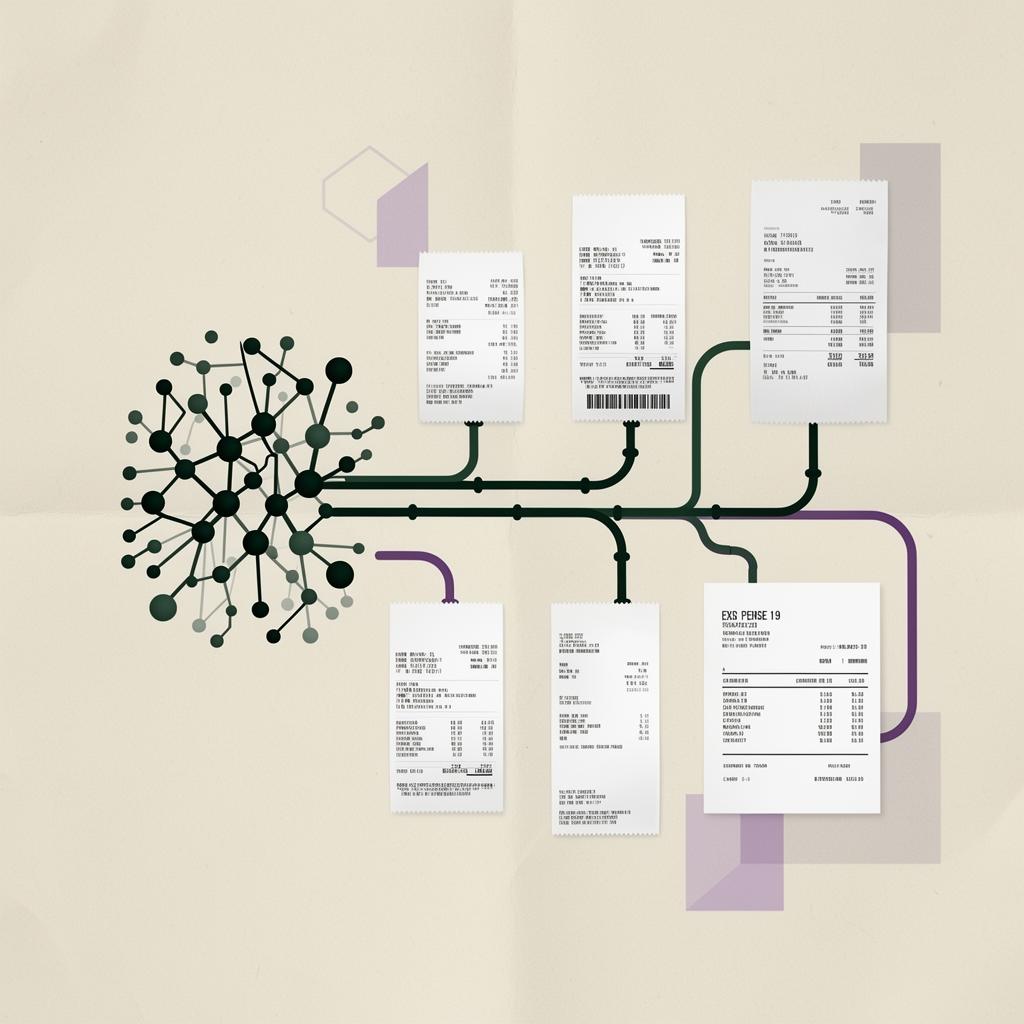
The architecture relies on four input sources — the digitised receipt, the card transaction, the company T&E policy, and the employee's SAP Concur context — which the agent synthesises into one of three outputs: automatic approval, escalation to the manager with justification, or rejection with an explanation.
Architecture du flux agentique — de la soumission à la décision
:::
Phase 1 — Encoding the policy is already an audit
The first step looked simple: feed the agent the rules of the expense policy. In practice, it was a merciless mirror.
The client's T&E policy was 34 pages long. Turning it into queryable rules surfaced internal contradictions (a hotel cap defined in two places with different values), blind spots (what to do with an annual subscription split into monthly instalments?), and well-intended rules that were unenforceable without context.
Encoding the policy for an agent is auditing it for the first time. The work produces a single source of truth used by both the agent and managers during escalations.
Preparation of data and T&E policy
Shadow mode — parallel decisions, no risk
Calibration of thresholds and escalation rules
Production with human supervision
Phase 2 — Shadow mode, or how to learn without risk
Before letting the agent make real decisions, we ran four weeks of shadow mode: the agent processed every expense report in parallel with humans, with no impact on the actual flow. The two streams were compared daily.
The initial agreement rate was 71%. The disagreements were instructive: 60% came from ambiguous rules that the agent interpreted strictly while humans applied undocumented case-by-case judgment. 25% were legitimate cases the agent could not yet handle. 15% were human errors the agent had correctly flagged.
Shadow mode reveals not only the agent's limits, but also the inconsistencies of your human processes.
The real surprise: the escalation rate
We had estimated that 8 to 10% of expense reports would need human review. The reality: 18%. Twice as much.
This does not mean the agent was overly cautious. It means we had underestimated the share of genuinely ambiguous cases in a standard T&E flow. Those 18% match exactly the situations where, before the agent, a human made a quick decision without really analysing — usually in favour of approval to avoid friction.
> "The amount of this meal (€142 for one person) exceeds the business-meal cap (€80) set in the policy dated March 15, 2024. Would a client-entertainment context justify an exception?"
Managers reported that those precise messages reduced the number of back-and-forths needed for clarification.
A good AI agent is not the one that automates the most — it is the one that escalates intelligently, with the context needed for the human to decide quickly and well.
Experiment summary — what the agent masters, what is still open
- Duplicate-receipt detection (>95% precision)
- Receipt ↔ card-transaction matching on amount + date + currency
- Automatic categorisation against internal policy
- Natural-language rejection messages
- Consistent 24/7 processing, no human variance
- The agent flagged policy inconsistencies humans were letting through
- The quality of escalation justifications reduced manager back-and-forth
- Ambiguous cases revealed undocumented grey zones in the policy
- Real escalation rate (18%) was 2× higher than estimated
- Multi-currency expenses with foreign VAT: conversion errors
- "Client entertainment" context hard to infer without history
- Handwritten or skewed receipts: upstream OCR failures
- Rule hallucination on extreme cases unseen in testing (<0.5%)
- −73% processing time on compliant expenses
- Complete and homogeneous audit trail on every decision
- Easier T&E policy updates: a single source of truth
- Aggregated anomaly data → quarterly insights for the CFO
The actual gains, soberly measured
Every decision produces a complete, time-stamped audit trail with a textual justification. For a CFO subject to audit obligations, that is a structural change. Aggregated anomaly data — expense categories that trigger the most escalations, atypical profiles, recurring out-of-policy suppliers — has become a source of quarterly insights.
What the agent cannot do yet
Honesty matters. Multi-currency expenses with foreign VAT exceed current capabilities: a reliable real-time conversion pipeline and country-level VAT recovery rules are required. Low-quality receipts degrade the upstream OCR — the agent detects the uncertainty and escalates, but this creates a volume of avoidable escalations.
Finally, a few edge cases unseen during training produced incorrect reasoning: the agent cited a rule that did not exist, reconstructing a logic from the surrounding context. These cases are rare (< 0.5%) but critical for trust — which justifies keeping a human in the loop on high-stake decisions.
What's next
The next step on our roadmap is integrating electronic invoicing flows — Factur-X, CII XML — into the agentic loop. A particularly relevant topic given the French e-invoicing reform (gradual rollout from 2026). The idea: let the agent automatically reconcile an expense with the matching supplier invoice, and flag discrepancies before they enter the payment flow.
Agentic AI is not a revolution falling from the sky. It is a progressive deployment that demands rigour on data preparation, pragmatism on confidence thresholds, and real reflection on what we actually want to automate. Done well, it changes the nature of T&E control: from reactive to preventive and systematic.